

You open your laptop, ready to write something amazing… and boom…nothing. Total brain freeze. The cursor just blinks at you like it’s mocking you. You try to think of a catchy hook, a clever angle, anything…but your mind’s suddenly as empty as that Google Doc. Sound familiar?
Yeah, we’ve all been there. You know what you want to say, but the words just won’t come out. The pressure kicks in, the clock’s ticking, and before you know it, an hour’s gone and you’re still stuck at square one.
The thing is…you’re not bad at writing. You just don’t have a system yet. That’s what content frameworks are for. They give you a plug-and-play structure so you can skip the overthinking and start creating fast. In this post, I’ll show you how to crank out winning content in 15 minutes flat…no burnout, no guesswork, no creative drama.
What Are Content Frameworks?
“Content frameworks” sound fancy, but they’re actually pretty simple. A content framework is just a structure that helps you turn your messy ideas into something clear and powerful.
When I use one, I’m not sitting there guessing what to say next. I already have a proven layout in front of me. Content frameworks are repeatable structures that turn “what do I even write?” into “okay, let’s just fill this out.”
They take away the mental chaos and help you move fast. You don’t have to overthink where to start or how to end. You just plug your ideas into a pattern that already works.
This isn’t about sounding robotic. It’s about saving time, cutting the overwhelm, and keeping your creative energy for what actually matters…your message. Once you’ve used a few frameworks, you’ll wonder how you ever wrote without them.
Also Read: How to Build a Winning Content Strategy for Your Business [+Template]
Strategy vs Execution: The Two-Layer Model
Here’s how I break it down. There are two layers to content: strategy and execution.
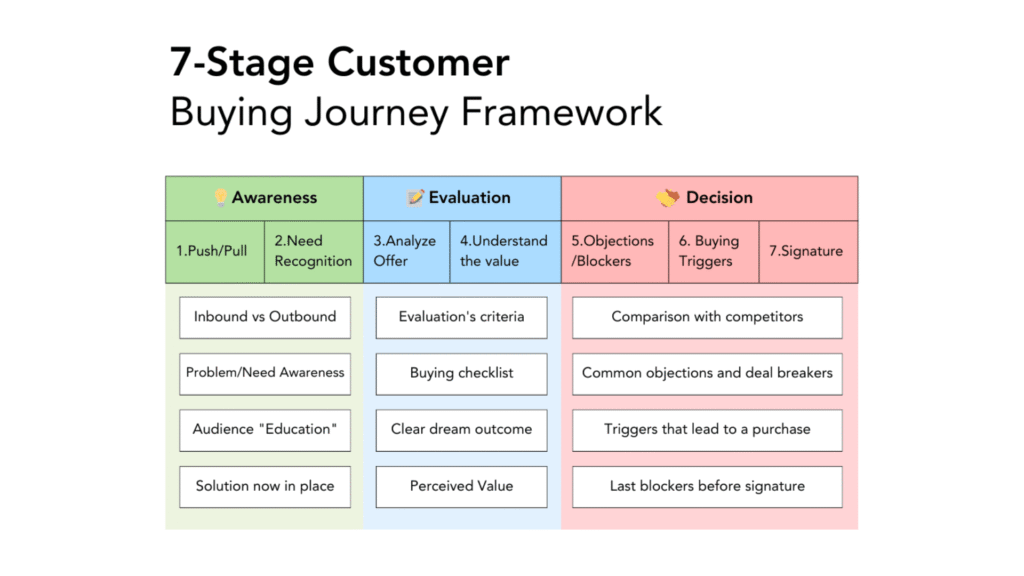
- Strategy layer (Content Marketing Frameworks): This is the big-picture stuff. Think content pillars, topic clusters, customer journey stages, and distribution plans. Basically, it’s how you decide what to talk about and where to publish it.
- Execution layer (Content Creation Frameworks): This is where the magic happens. Frameworks like AIDA, PAS, SPARK, BAB, FAB, and 4P’s help you turn your ideas into posts, emails, ads, or landing pages. They tell you exactly how to structure your message so it flows naturally and drives action.
I like to think of it like this: strategy sets the direction, execution hits the gas.
Why Frameworks Beat the Blank Screen
You know that soul-crushing moment when your brain freezes and your screen’s empty? Yeah, frameworks fix that.
Here’s why they work so well:
- They narrow choices fast. You stop overthinking because you already have a starting point.
- They force clarity. Every framework pushes you to connect goal → proof → CTA. No fluff. No filler.
- They scale across channels. Once you nail a message using a framework, you can reuse it for social posts, blogs, emails…without sounding robotic or repetitive.
The 15-Minute Content Creation Framework (Step-by-Step)
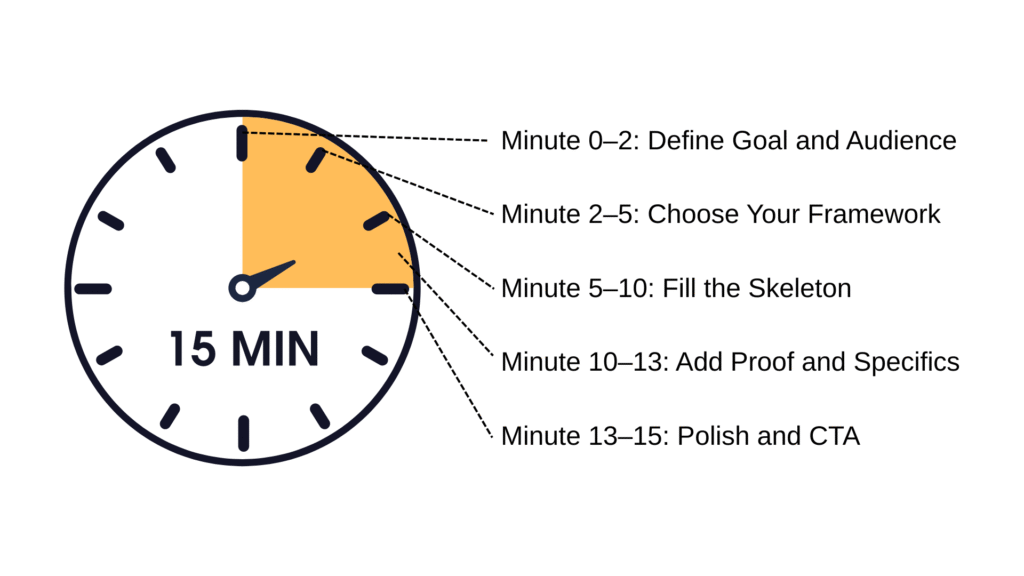
Minute 0–2: Define Goal and Audience
First, I pick one goal. Click, sign up, share, reply, or buy. Only one.
Then I name the reader. Who are they, what do they want, what blocks them.
Quick fill:
- Goal: what action I want right now
- Audience: who I’m speaking to
- Pain: one problem they feel
- Outcome: one result they crave
- Proof: one fact or example I can show
Fast prompt I use:
- “I’m writing to [audience] who struggle with [pain]. I want them to [goal]. The win is [outcome]. My proof is [proof].”
Done. Move on.
Minute 2–5: Choose Your Framework
I match the goal to the structure.
- Need clicks or signups: AIDA
- Need to fix a pain: PAS
- Need to show value: FAB or 4P’s
- Need a quick spark post: SPARK
- Need a short story: BAB
Pick one. Commit. No second guessing.
Micro-setup examples:
- AIDA: Hook, reason to care, desire builder, clear action
- PAS: Name the pain, make it real, solve it clean
- BAB: Before state, after state, bridge that gap
I write those four or five labels on the page. That’s my skeleton.
Minute 5–10: Fill the Skeleton
I write ugly first. And I don’t edit. Anddd I move fast.
Guidelines I follow:
- One idea per line
- Short sentences
- Simple words
- Talk to one person
- Cut filler on the fly
Helpful starters:
- Hook: “Here’s the problem everyone ignores.”
- Pain: “You try X, yet Y keeps happening.”
- Desire: “Imagine Z by next week.”
- Bridge: “Here’s the small step that gets you there.”
- Action: “Do this now, then this.”
I add one proof. A stat, a screenshot idea, a quote, a mini case, or a quick demo line.
I drop one visual note if needed:
- “Insert chart of results”
- “Add gif of workflow”
- “Add bullet list of steps”
Minute 10–13: Add Proof and Specifics
This is where trust clicks in.
I plug in specifics:
- Numbers: real ranges, not fluff
- Names: tool, method, resource
- Steps: 1, 2, 3, no mystery
- Timeframes: today, this week, 30 days
Proof menu I use:
- Tiny case: “Sam applied step 2, got 18 percent more clicks in 7 days.”
- Data point: “Open rates rose from 22 percent to 34 percent.”
- Quote: one line from a user or expert
- Screenshot note: “Show results table”
I swap weak claims with measurable lines. If I can’t prove it, I cut it.
Minute 13–15: Polish and CTA
Three minutes to tighten and ship.
Polish checklist
- Kill repeats.
- Break long lines.
- Replace vague words with exact ones.
- Check the hook. Clear promise in line one.
- Check the goal. One action, one link.
CTA menu
- “Download the 15-minute checklist.”
- “Copy the AIDA card.”
- “Reply with your niche and I’ll suggest a framework.”
- “Start your first 15-minute sprint now.”
CTA rule
- Make the next step specific. Add the time hint.
- “Download the checklist and try it today.”
Hit publish.
Example: Applying the 15-Minute System
Let’s say you’re selling a Notion content calendar built for busy B2B founders who want to market consistently without living on LinkedIn 24/7.
Timer set. 15 minutes. Let’s go.
Minute 0–2: Define Goal and Audience
Goal: Get founders to sign up for your Notion content calendar.
Audience: Bootstrapped founders juggling everything — product, clients, and marketing — while trying not to burn out.
Pain: They know they need to post content, but it always falls to the bottom of the to-do list.
Outcome: A clear system that handles planning, scheduling, and tracking content in minutes, not hours.
Proof: 300+ founders already using it to stay consistent and grow faster.
You don’t need a perfect persona doc. Just one clear sentence like this:
“I’m writing to founders who can’t keep up with content because they’re doing too much. I want them to sign up for a Notion content calendar that runs their marketing on autopilot.”
Boom. Clarity done.
Minute 2–5: Choose Framework
The goal is signups, and the audience feels the pain hard…so I pick PAS (Pain → Agitation → Solution).
PAS Template:
- Pain: Name the problem.
- Agitation: Make it sting a little (they should feel, “yep, that’s me”).
- Solution: Offer the fix, clearly and calmly.
It’s direct, emotional, and perfect for B2B founders who don’t have time for fluff.
Minute 5–10: Fill the Skeleton
Write fast. Don’t edit yet.
Pain:
You know you should post more on LinkedIn, but there’s always something more “urgent.” A client call. A bug fix. An invoice. Marketing ends up buried under “later.”
Agitation:
Then “later” turns into weeks. Your competitors show up daily, while you’re stuck rewriting the same half-finished draft in Google Docs. You scroll, you sigh, and tell yourself you’ll start fresh next Monday.
Solution:
Meet the Notion Content Calendar, the simple system built for founders who hate overcomplicating marketing. Plan, write, and schedule in one dashboard. 15 minutes a week. Zero chaos.
That’s the core message written in 5 minutes flat.
Minute 10–13: Add Proof and Specifics
Now it’s time to make it feel real. Add a touch of data, social proof, and visual cues.
Proof ideas:
- “Used by 300+ founders across SaaS, consulting, and B2B services.”
- “Most users go from 1 post a month to 4 posts a week in under two weeks.”
- Screenshot or short clip of the Notion dashboard.
Specific line example:
“Last month, Sarah, a solo SaaS founder used it to batch four weeks of posts in one sitting. Her post reach jumped 4x, and she stopped writing at midnight.”
That one small story makes it believable.
Minute 13–15: Polish and CTA
Now we tighten. Remove filler. Break long lines. Add a clear call to action.
Final Copy (Clean Version):
You know you should post more on LinkedIn, but there’s always something “more important.” A client call. A feature to test. Marketing slips off your radar again.
Then weeks pass. Your competitors keep showing up. You keep opening the same half-finished draft, trying to make it sound smart.
The Notion Content Calendar fixes that. It’s built for busy founders who want a system that actually works.
Plan, create, and schedule in one clean dashboard. 15 minutes a week. Done.
300+ founders use it to stay consistent and visible, without hiring a team.
👉 Get your Notion Content Calendar today and publish your next post by Friday.
eBook: 59 Powerful & Proven Content Frameworks [50,000,000 views & $10,000,000 in sales]
Alright, let’s talk about something I wish I had years ago…a single resource with every content framework that actually works.
When I first started creating content, I was that person who opened a doc and typed… nothing. Then I’d scroll through endless “content tips” threads on Twitter, trying to piece together something useful. Total chaos.
That’s exactly why I built (and now use every day) the eBook: 59 Powerful & Proven Content Frameworks, a complete library of the formulas that top creators and brands use to get results fast.
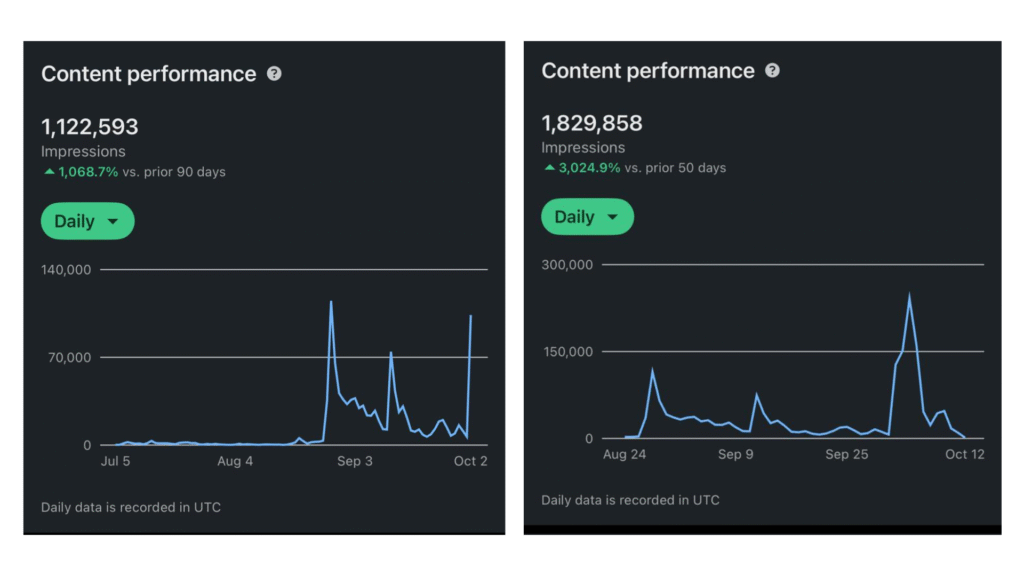
And when I say results, I mean real ones…these frameworks have generated over 50,000,000 views and $10,000,000 in sales across different creators, campaigns, and platforms.
And these are results from my clients for whom I use these frameworks:
What You Get Inside
Let’s break it down. Inside the eBook, you’ll find:
- 59 proven content frameworks that cover everything…from ads, emails, and posts to landing pages and storytelling.
- Real-world examples from brands like Apple, Nike, HubSpot, and solo founders who mastered them.
- One-liner cheat sheets for each framework so you can build your post in minutes.
It’s like a Swiss army knife for content creators — everything you need in one file, organized by goal. Whether you’re trying to sell, educate, inspire, or entertain, there’s a framework that fits perfectly.
How It Accelerates the 15-Minute Method
This eBook and the 15-minute content system are made for each other.
You can open the eBook, pick a framework that fits your goal, and plug it straight into your 15-minute workflow. That means:
- No time wasted trying to “figure out what to write.”
- No guessing what headline or structure works best.
- No freezing up mid-draft, wondering if it’s good enough.
Every framework comes with a built-in prompt and skeleton …so when your timer starts, you already have a roadmap.
That’s it. You’ve got 59 ready-to-use blueprints, so you’ll never run out of ideas again.
![sneak peek into the eBook: 59 Powerful & Proven Content Frameworks [50,000,000 views & $10,000,000 in sales]](https://blog.aleenashahid.com/wp-content/uploads/2025/10/content-creation-framework-1-1024x576.png)
Wrapping Up: Content Frameworks
I don’t wait for inspiration. I use structure. It keeps me fast, clear and shipping.
You can do the same starting today. Set a timer. Pick one goal. Choose one framework. Fill four or five lines. Add one proof. Polish for three minutes. Publish. Simple beats clever.
If you want a nudge, steal my toolkit. The strategy template helps you sprint. The content ideas bank keeps you consistent. The eBook gives you 59 proven patterns so you never stall.
Let’s make publishing feel easy. Every single week.